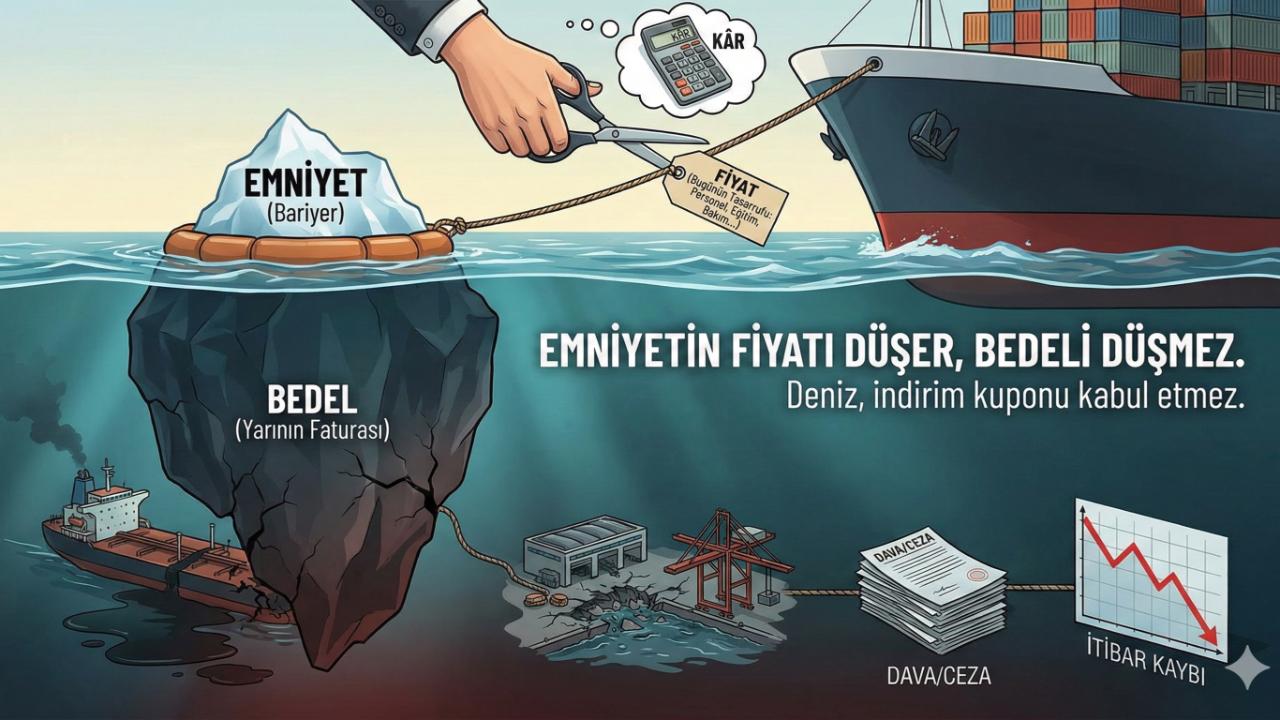
Pilot captain salaries have fallen to $3,000-$4,000, raising serious safety and operational concerns in the maritime industry.
Half salary, full responsibility.
The issue discussed in pilotage cannot be brushed off as 'income loss of a profession.' According to field sources, the reduction of monthly incomes, which were in the range of $7,000 to $8,000 before tenders, to $3,000 to $4,000 creates a situation that is openly inversely proportional to the risk profile of the duty. The pilot is not a 'consultant' in a maneuver decided in seconds under narrow waterways, wind/current; he is the living insurance of safety. When the premium of the insurance is halved, the coverage of the policy does not increase; it becomes easier to breach.
The mathematics of the tender: As the public share grows, the payroll shrinks.
In the sector analysis published in 7deniz in October 2025, it is emphasized that the public share in pilotage tenders has climbed to the range of 80-95%, leaving the operator with a gross margin of only 5-20%; this margin will struggle to cover 24/7 shifts, boats/reserve boats, maintenance, insurance, and especially pilot captain salaries and training expenses. At this point, the 'decrease in salary' is not surprising; it is a natural consequence of the tender model.
In the interview published in DenizHaber with Recep Düzgit, the same risk is described in more explicit language: Unless an upper limit is set for the public share ratio, as the ratio increases, the company’s profitability decreases; this can indirectly harm service quality and employee rights. Moreover, the pressure can extend to the pilot captain's salary, rest schedule, and working hours. The 'drop' of the salary to $3,000 to $4,000 is actually the first visible output of this compression on the payroll.
Not a 'commercial activity,' but a safety service: objections from professional organizations.
The Chamber of Marine Engineering (GEMİMO) states in a statement published in December 2025 that pilotage and towing are not just operational support; they are a public duty related to life, property, environment, and national security. The same text reminds that the pilot captain must be able to prioritize navigation safety without any commercial/administrative pressure, relating it to the notification obligation in the Ports Regulation.
The critical sentence of the statement is as follows: While the public share reaching 90% may initially seem like a 'public benefit,' it is noted that the economic pressure first weakens the social rights and income security of the pilot captain; it can create an environment that negatively affects motivation and attention levels, potentially jeopardizing safety in high-risk navigation areas. This frames the 'salary issue' as a direct 'safety issue' within a legal context.
International warning: Competitive pressure does not enhance safety.
Although the discussion in Turkey is presented as new, the argument that pushing pilotage into a competitive cost race reduces safety has been present in international texts for years. IMPA’s (International Maritime Pilots’ Association) position paper on 'competition in pilotage' argues that safety levels decrease in a competitive environment and that there are no incentives for proper training; it claims that short-term contracts weaken recruitment, training, and succession planning.
In IMPA’s safety brochure, pilotage is explicitly framed as a 'mandatory/fundamental public service'; it emphasizes that public interest is better protected through a fully regulated and comprehensive pilotage service free from commercial pressure. The message here is simple: There is no such thing as 'cheap safety'; there is only a deferred bill.
IMO standard: Local knowledge, training, and procedural continuity.
The IMO resolution A.960(23) acknowledges that pilotage requires expertise and experience specific to a certain area; it calls on states to implement training, certification, and operational procedure recommendations. The IMO’s page on pilotage also confirms the same framework.
In Turkey, the purpose of the 'Directive on the Safety of Pilotage Services' published by the Ministry of Transport and Infrastructure is expressed as establishing procedures and principles aimed at increasing the safety of life and property for pilot captains and personnel during pilotage services. In other words, even the legal language states: The essence of this job is 'safety'; however, when the tender structure rewards maximizing public share instead of safety, a contradictory public policy emerges.
What falls when salaries drop? First 'quality,' then 'institutional memory.'
Where field sources say 'salary $3,000 to $4,000,' the real break point is the capacity to retain qualified personnel in the system. Pilotage is a skilled profession; regional knowledge, local current-wind characteristics, docking habits, tug coordination, VTS interaction, maneuver reflexes according to ship types… These are not items that can be 'purchased' at a desk; they are the accumulation of years.
If public share pressure begins to view the training budget as a 'cuttable expense'; if it pushes towards 'maintaining minimum crew' instead of retaining experienced captains; if the rest schedule deteriorates… a decline in quality is not an opinion, but a result. The interview in DenizHaber also clearly states that cost pressure can lead to risks such as cutting mandatory investments, avoiding qualified personnel, or providing services with inadequate infrastructure.
If the pilot captain considers returning to the sea.
It is not surprising that many pilot captains are considering returning to the ship at this salary level. It is already a known fact in the sector that working as a captain on a ship offers a much higher income band (especially on certain routes and ship types); if pilotage, despite being a high-risk duty, is treated as a 'cost item to be discounted,' the loss of human resources will accelerate. At this point, the issue transcends the debate of 'who is right': The system pushes experience from land to sea.
Port economy and environment: The cost of a mistake cannot be measured by salary.
The pilot captain is often the first and last citizen of the Republic of Turkey seen by the foreign ship captain and crew; this symbolic aspect is the showcase of the job. Behind the scenes, however, lies the port economy and marine environment. It can be seen in academic evaluations of legal and environmental consequences of major maritime accidents, such as the Independenta incident, that the environmental and economic impacts of a major maritime accident can last for years.
Therefore, the balance sheet that rejoices in 'we increased the public share' can write much larger figures in the 'public loss' column after an accident. Maritime safety is not a budget item; it is risk management.
Where does the solution look? Cap on public share, corridor for wages, criteria for safety.
The analysis in 7deniz directly links the solution discussion to 'contract design': It proposes determining the minimum safety cost with an independent methodology; setting a cap on the public share; including a minimum training budget and wage corridor in contracts; and publishing cancellation/approval justifications in a standard format. The common idea of this approach is this: The financing of safety cannot be left to 'God knows' after the tender; it must be embedded in the tender specifications.
Final word: Reducing the pilot captain's salary from $7,000-$8,000 to $3,000-$4,000 is not 'savings'; it is an attempt to cheapen risk. The sea does not come to such bargaining. The price of safety can be lowered; but the cost does not decrease.
Source: SeaNews Türkiye