
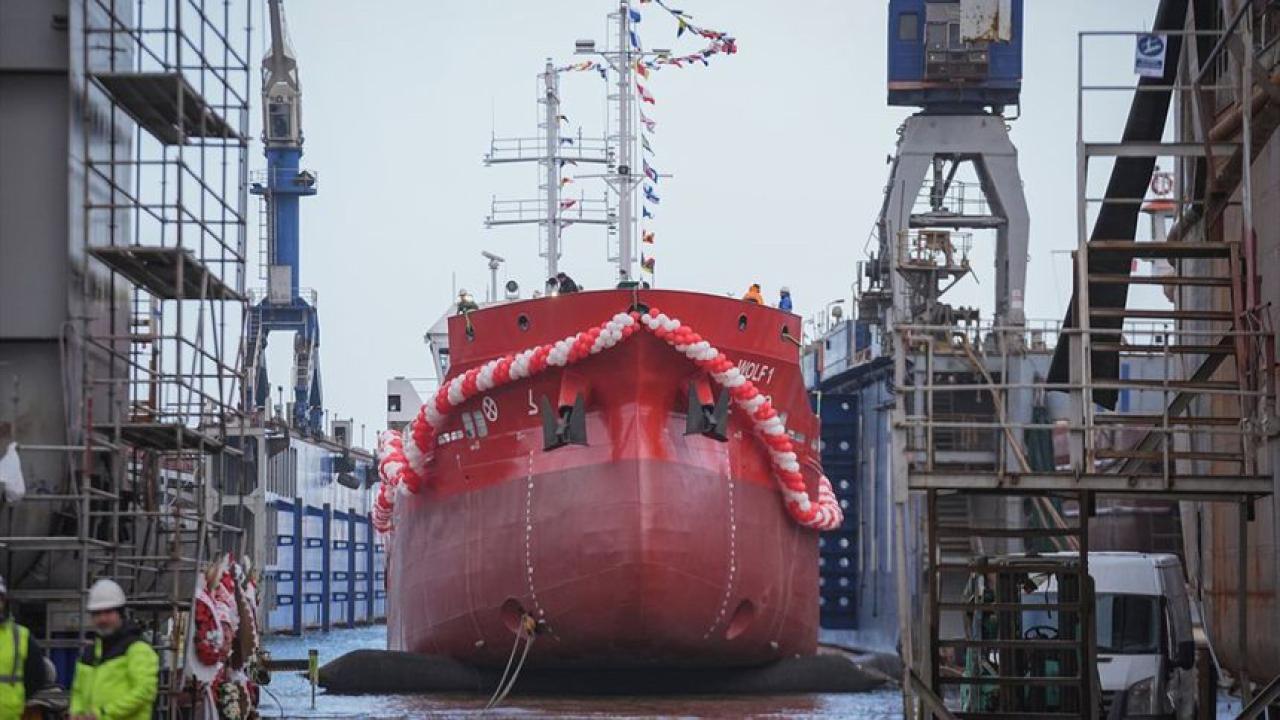
Petrol Ofisi's 'Wolf 1' is Turkey's inaugural zero-emission tanker, highlighting the nation's shipbuilding capabilities and dedication to sustainability.
During the launching ceremony of the ship named 'Wolf 1,' belonging to the Petrol Ofisi Group, Deputy Minister of Transport and Infrastructure Durmuş Ünüvar stated, 'Turkey's shipbuilding industry ranks high globally, and the ability to build ships is a significant capability for a country. Turkey possesses this capability.'
The first zero-emission tanker 'Wolf 1,' completed as part of the collaboration between Petrol Ofisi Group and Hicri Ercili Group, was launched into the water at a ceremony. As part of the agreement made last year to renew its tanker fleet with environmentally friendly modern technologies, Petrol Ofisi Group will have three new tanker ships, each with a capacity of 1750 deadweight tons (DWT), constructed at the shipyard in Yalova by Hicri Ercili Group.
According to the statement, Petrol Ofisi, which launched the first of the four ships at the Hicri Ercili Group shipyard in Yalova with a ceremony, is renewing its fleet while also adding value to Turkey’s energy infrastructure through domestic and national production.
In his speech at the ceremony, Deputy Minister of Transport and Infrastructure Durmuş Ünüvar said they came together to witness another ship that they would be proud of while sailing.
Emphasizing that the steps taken to grow the maritime trade fleet and enhance the capacities of ports and shipyards allow them to experience the rightful pride of having a stronger and more competitive maritime sector, Ünüvar stated: 'Since its establishment, the Republic of Turkey has overcome every challenge it has faced in the past century and has succeeded in positioning itself among the developed countries of the world in line with its goal of exceeding the level of contemporary civilizations. With its strategic location, dynamic workforce, and rapidly developing production capacity, Turkey stands out as an important economic actor at both regional and global levels. Our country is one of the fastest-growing economies globally.'
'This ship that has met the sea is an important indicator of the point our industry has reached.'
Ünüvar pointed out that Turkey's location at the intersection of three continents provides direct access to the markets of Europe, the Middle East, Central Asia, and Africa, and continued: 'Our shipyards, which embody the productivity and determination of our people by signing new generation ship projects that harbor high technology, hold an important place in our country's employment and development goals. This ship that has met the sea is also an important indicator of the point our shipbuilding industry has reached. Our ports, shipbuilding industry, shipowners, ship recyclers, and repair and maintenance workers are achieving various successes in different fields. We are fully confident that our yacht manufacturers will continue to achieve success, as they combine traditional construction skills with modern techniques, resulting in our producers rising to second place in the world in terms of total length in yacht project order books by 2025.'
Noting that an export of 2.4 billion dollars was achieved in 2025 and that the kilogram value in yacht construction could reach around 40 dollars, which is a significant indicator, Ünüvar recorded:
'Another of the most important indicators of effectiveness in maritime transportation is having a strong fleet. In the first half of 2025, Turkey rose to 10th place in the world with 2,203 ships and a carrying capacity of 53.1 million tons. While more effort is being made every day to solve environmental concerns through collective intelligence on a global scale, the importance of developments in the logistics network, such as the ships we launch into the sea, cannot be underestimated. With our determination to increase the environmental sustainability of our maritime sector, we will make significant contributions to both environmental protection and the reduction of greenhouse gas emissions from our ships through our renewed and transformed maritime trade fleet. Our ministry, which always prioritizes its responsibilities to society and nature, strives to balance economic growth with environmental sustainability.'
Ünüvar stated that nearly 90% of global maritime trade occurs via sea and emphasized that the increase in trade volume due to new ships meeting the seas would also lead to more fuel consumption and emissions. He noted that the International Maritime Organization draws attention to energy efficiency initiatives to reduce the negative impacts of ships and encourages the sector in this regard, stating: 'We are seriously following these green transformation issues internationally, prioritizing our national interests, and playing an active role in the decisions to be made in this regard. In terms of our facilities and capabilities, Turkey ranks among the leading countries in the construction of autonomous and unmanned marine vehicles, as well as ships with LNG, electric, or hybrid systems, which we can call the vessels of the future. Some of these have been constructed for the first time in Turkish shipyards. Our 60-meter-long and 1750 deadweight ship, which we launched, will also enter the ranks as the first zero-emission ship built for cabotage service.'
Ünüvar expressed, 'We are very happy to have launched our zero-emission ship named Wolf 1. Turkey's shipbuilding industry ranks high globally, and the ability to build ships is a significant capability for a country. Turkey possesses this capability. We have a structure that can continuously build first-type ships in the world. Hopefully, these investments will continue at an even faster pace. I am sure that Turkish shipyards will accomplish much better works.'
'We have been the clear leader in maritime fuel sales for six consecutive years.'
Mehmet Abbasoğlu, CEO of Petrol Ofisi Group, stated that they have reaped the first fruits of a project that will add value to the international reputation of the maritime sector, which has become a global player that will strengthen the blue homeland together.
'Blue economy is one of the biggest drivers of our foreign trade. Approximately 90% of international trade occurs at sea,' said Abbasoğlu, and continued:
'Thanks to the investments made in recent years, our maritime trade fleet ranks among the top 10 in the world. The strategic position of maritime in the geopolitical agenda plays a vital role in Turkey's goal of complete independence in energy and the energy transition agenda. We are fortunate that Petrol Ofisi Group is part of this picture and can contribute. We have been the clear leader in maritime fuel sales for six consecutive years. We are proud to be a reliable partner for both the private sector and the public. In the petroleum and natural gas exploration efforts of our country, we are replacing the entire sector in fuel supply for vessels operating in Filyos Zonguldak, as well as in Mersin and Ordu. As a company with the youngest barge fleet in Turkey, we also cover 20% of the active barges. We are very pleased to introduce our innovative solutions, which we owe our position to, to our stakeholders.'
'The zero-emission fuel supply tanker will serve as an example in global waters.'
Abbasoğlu emphasized that projects developed with common wisdom and conscience constitute the most important key to sustainable development, noting that the project they realized with Hicri Ercili carries special importance for this reason.
'Maritime trade and maritime supply are critical for Petrol Ofisi Group,' said Abbasoğlu, continuing: 'It is one of our fastest-growing sectors. In this context, launching our Wolf 1 barge here, with the efforts of Turkish engineers at local shipyards, is a source of pride for us. Three more barges, Wolf 2, Wolf 3, and Wolf 4, are still on the slipway. They will also be operational as soon as possible. As the first of a series of four tankers, Wolf 1 contains a unique first for the future of our sector. The zero-emission fuel supply tanker will undoubtedly serve as an example in regional and global waters. In line with our ministry's motto of safe, secure, and sustainable maritime operations in clean seas, we will continue to increase these pioneering investments and sign value-added projects in the century of Turkey.'
'Constructed uniquely for transporting alternative fuels.'
Murat Ercili, Chairman of the Board of Hicri Ercili, recalled that the four-series ship they launched is characterized as a zero-emission and environmentally friendly vessel. He also mentioned that Turkey's first environmentally friendly stainless chemical tanker project, which they realized with the support of the Ministry of Transport and Infrastructure, is still ongoing, stating: 'The production of two tankers is continuing at our shipyard, scheduled for delivery in 2026. Additionally, a completely closed system equipped 3,000-ton submarine floating dock, which is unique in the world for meeting the Turkish Naval Forces Command's submarine construction and modernization needs, has been successfully produced and delivered to our naval forces. It will be used for transporting alternative fuels, constructed uniquely in its class, with fully automated structures that will save time with high discharge capacities. It will enhance service quality. With its zero-emission features, it will operate in an environmentally friendly manner and create significant value and prestige for both institutions.'
After the presentation of plaques, Deputy Minister of Transport and Infrastructure Durmuş Ünüvar, CEO of Petrol Ofisi Group Mehmet Abbasoğlu, and Chairman of the Board of Hicri Ercili Murat Ercili cut the ribbon, bringing the ship named Wolf 1 together with the blue waters.
Source: SeaNews Türkiye


