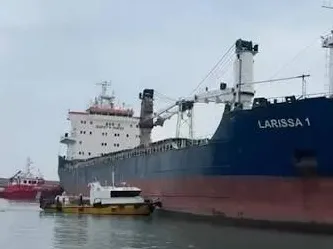

A new high-risk area in the Black Sea offers additional pay and security for seafarers starting November 26, 2026.
New Crew Risk Area in the Black Sea: Daily Additional Basic Wage for Affected Seafarers
An agreement between Norwegian shipowners and seafarer unions introduces additional payments and special security measures for crews working in a designated area of the Black Sea defined by coordinates. The regulation, which comes into effect on November 26, 2026, at 02:00 Turkish time, will apply based on the contract of the ship and the seafarer. Bulgaria has also issued a navigation warning regarding the KAIROS, which ran aground in Sozopol Bay.
The Norwegian Shipowners' Association and unions representing seafarers, deck officers, and marine engineers in Norway reached an agreement on November 25 for a new high-risk area in the Black Sea. The protocol regulates the additional rights that seafarers on covered vessels will receive when working in this area and the security measures that will be implemented on board. (Protocol dated November 25, 2026)
The practical implication of the decision is as follows: If a vessel enters the designated area and the crew's contract falls under this agreement, a risk payment arises for the days spent in the area, in addition to the normal wage. Furthermore, appropriate special security measures must be implemented for the vessel. The rights of the seafarer regarding whether to continue serving on that voyage are also evaluated separately.
Two separate conditions are sought here: the location of the vessel and the contract under which the seafarer is working. Merely being in the Black Sea does not create an automatic payment right from this protocol for all seafarers.
The new high-risk area is located south of the existing military operations area. The boundary is drawn with coordinates in the protocol; a 12 nautical mile strip off the coasts of Romania and Bulgaria is excluded. Therefore, the application cannot be determined solely by looking at the name of the destination port. The route taken by the vessel while approaching the port and the time spent within the defined area will also be significant. (Geographical scope of the protocol)
For example, a vessel heading to a port in Romania may pass through a portion of the new high-risk area. In such a case, merely having the destination port on the coast does not mean that the entire journey is exempt. Similarly, the exclusion of the 12 nautical mile coastal strip from this payment arrangement does not imply that there are no navigational hazards in those waters.
The regulation covers the NOR and Nordic NIS agreements between the parties, as well as agreements related to NIS vessels and certain foreign flag model contracts for non-Norwegian seafarers. NOR refers to Norway's ordinary ship register, while NIS refers to the international ship register. However, in determining the payment right, the registry information will be examined along with the relevant employment and collective labor agreements. Therefore, it is not sufficient to only look at the seafarer's nationality or the flag of the vessel. (Norwegian Maritime Administration — ship registries, provision of the protocol)
The amount used to calculate the additional payment is a daily basic wage. The protocol stipulates additional payment for each day spent operating, transiting, or docking in the designated area.
Let’s provide a hypothetical example to simplify the calculation: Suppose a seafarer's daily basic wage is 100 euros. If the vessel remains in the area covered by the agreement for four full days, a risk addition of 400 euros will be calculated for those four days. The seafarer's normal wage entitlement continues as well. The 100 euros mentioned here is merely an illustrative figure used for the calculation.
This application does not mean that the entire monthly salary or every item on the payroll is doubled. The calculation is based on the basic wage and the days spent in the covered area. The protocol also excludes the risk addition from the calculation of leave pay; other payments calculated based on the basic wage are not counted within this addition. (Wage provisions of the protocol)
Another important aspect of the regulation is the right to withdraw from service on the vessel. The protocol references the provisions of the Norwegian Maritime Labor Act concerning war or war-like conditions. The law regulates that this right can be exercised before leaving the port under the relevant conditions or at the first port of call after the situation is learned. (Norwegian Maritime Labor Act, Article 9-5)
For those working under temporary NIS and model contracts, the relevant contract provision regarding prior notification about the risk and written consent before entering the area is also significant. Therefore, this heading cannot be reduced to a single rule that applies uniformly to every seafarer. It must be clearly stated what information was provided to the seafarer before the voyage and which contract is applicable.
The additional payment does not replace security measures. The protocol requires that special measures be implemented based on the type, size, speed of the vessel, and the height between the water surface and the main deck, in line with current BMP security practices. In other words, merely providing a wage addition without assessing the vessel's characteristics and the risks it will face does not meet the security aspect of the regulation. (Security and withdrawal from service provisions of the protocol)
The new text replaces the expanded area protocol dated September 5, 2023. In contrast, the military operations area protocol dated March 3, 2022, concerning the Sea of Azov, the Black Sea, and Ukrainian ports remains in effect. Therefore, it should not be concluded that all previous regulations have been abolished or that there is now only a single risk area for the Black Sea.
A separate evaluation is also required on the insurance side. This agreement pertains to the working conditions and rights of seafarers. It does not alter the war risk areas of the JWC; it does not automatically expand or narrow the P&I policy. The JWC lists relate to the assessments of the insurance market; their application to individual contracts is determined separately. The entitlement of the crew to the risk addition and the coverage of specific damages by insurance are different matters. (JWC — JWLA-035)
The cost-sharing between the shipowner and the charterer will also be addressed separately from the crew's wage entitlement. For example, if BIMCO's CONWARTIME 2025 clause is included in the contract and the relevant conditions arise, it regulates the collection of additional wages paid to the crew due to war risk by documenting them and charging them to the charterer. However, this provision does not automatically apply to all charter contracts. Therefore, the signing of the Norwegian protocol does not ensure that every additional expense is automatically charged to the charterer. (BIMCO — CONWARTIME 2025, Article e)
In practical terms, this development means that the route and the crew contract should be checked together during voyage preparations. The operator needs to determine on which dates the vessel will enter the defined area, which crew members are covered by the agreement, and how the additional wage calculation will be made. The cost-sharing in the charter contract is also added as a separate heading to this preparation.
Separately, Bulgaria's navigation warning number 877/26 reports that the vessel KAIROS ran aground in Sozopol Bay on November 28, 2026, at 17:55 UTC, which is 20:55 Turkish time. The position given in the warning is 42°24.65′ North and 027°43.63′ East. It is stated that the vessel is unlit, unable to maneuver, and poses a navigational hazard. (Bulgarian VTMIS — warning number 877/26)
Bulgarian authorities are requesting vessels in the area to navigate with increased caution and maintain a safe distance from the KAIROS. The bulletin does not contain a port closure announcement and does not specify a numerical safety distance. Additionally, the reason for the grounding does not provide information about the vessel's cargo or possible leakage. Therefore, no conclusions can be drawn from this warning regarding an attack, environmental pollution, or the closure of the port to all traffic.
Source: SeaNews Türkiye