IMO AIS guidelines: Collision Avoidance, Decision Making, and the Totem ECDIS Decision Support Tools
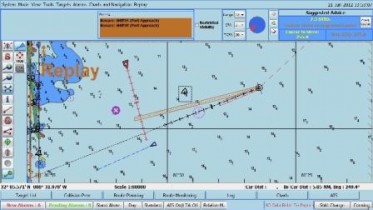
Since the introduction of AIS in 2001, the question of “how to use AIS data on board” remains unclear. The “International Regulations for Preventing Collisions at sea 1972 (COLREGS)" have no reference to AIS but only to Radar. Consequently, many mariners are under the impression that AIS information SHOULD NOT be used for collision avoidance. This attitude is heard from many officers and Masters, possibly coming from wrong interpretation of the rules by some marine schools. In this article we will press the point that AIS information SHOULD be used for collision avoidance.Naturally, a reader who is familiar with the COLREGS will counter the opposing reasoning above and will immediately quote rule 7(a), which says "Every vessel shall use all available means appropriate", and consequently AIS should be used if available. But mariners are not supposed to be legal experts, and should not be in a position where interpretations should be applied. In order to further understand this issue, one must go back to the original guidelines given by IMO on “Use of AIS in Collision Avoidance Situations”. These guidelines are part of IMO Resolution A.917 (22), adopted on 29 November 2001, an extract of which is given below (fig. 1). Those guidelines, incidentally, are set to be revised by IMO in 2014. Use of AISReading the guidelines, the text is indeed self explanatory. The guidelines state that “AIS is an additional source of navigational information”, and further that “AIS can assist in tracking it {a detected ship} as a target”. Combining the above with the COLREGS requirement that the Officer Of the Watch (OOW) should use “all available means”, it is a clear indication that IMO intended the AIS to be used to avoid collision. However, a word of caution should be included: the guidelines also warn that the mariner should not rely on AIS alone, and should not use the AIS as an excuse to slacken his lookout or responsibility. This statement agrees fully with COLREGS requirements for good seamanship and proper look-out. Possibly the reader should also be aware that, in interpreting AIS data by ECDIS systems, the good practice is to use the target positions only and not trust the SOG (Speed Over Ground) and COG (Course Over Ground) computed and sent by the target’s AIS transmitter. Those parameters are calculated separately using the Kalman algorithm, as is customary with ARPA systems. Decision SupportItem 40 of the AIS guidelines clearly state that “AIS information may be used to assist in collision avoidance decision making”. Decision making is precisely the process where TOTEM ECDIS provides unique Decision Support Tools. Such tools give the OOW the suggested course of action, either the exact course change or the exact speed change that is advised in order to avoid collision. With Decision Support Tools, the Decision Making process becomes more methodical and the right decision is more often taken. Totem Ecdis is complying with all the above IMO guidelines, in particular with items 40.1, 41 and 43, and is fully compatible with COLREGS. It is important to emphasize here that, complying with IMO guidelines, the decision support tools are based on both AIS and ARPA information. An example on how Totem Ecdis can help and give Decision Support in close proximity situations is shown below, taken from a real situation onboard a fast car carrier in the North Sea. In fig.2 one can see the vessel steaming on a course of 120°T at 15.7 Knots, with about a dozen targets (both AIS and ARPA targets) in close proximity. As seen in this picture, the Advise of the system is to turn 18° to Starboard and steer 140°T, in order to stay 0.5 miles from all targets (see CPA window). The decision by the OOW was taken accordingly, and the course was changed to starboard and set on 140°T - see fig. 3 which shows the situation after the course change. On this new course the vessel will pass on a safe distance from all targets, keeping the required minimum CPA (Closest Point of Approach) appropriate to this area (0.5 miles). SummaryDecision Support Tools are already used for other aspects of navigation, notably for Grounding Avoidance and Route Planning. The adoption of Collision Avoidance tools as offered by Totem ECDIS is a natural step forward. The attitude that we initially noticed with some navigators, namely “we know the rules of the road, we don’t need the machine to tell us what to do” is sometimes there. But if everybody knows the rules, why do we have so many collisions? The answer is possibly more and better training, better education and better performance monitoring. Totem ECDIS offers, in addition to the above, advanced Decision Support Tools that can improve safety and provide the ability to avoid dangerous situations. Collision Avoidance will, consequently, save lives at sea.