The SITC YIHE vessel marks the inaugural international liner service at Guangzhou Nansha Phase IV, enhancing trade efficiency in the region.
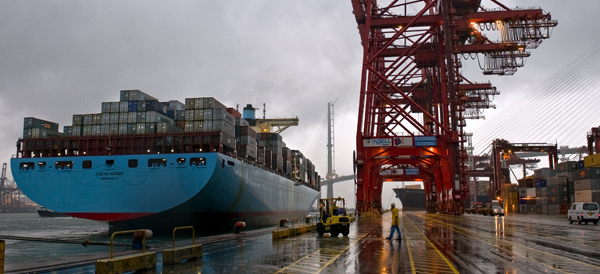
The vessel 'SITC YIHE' has completed its berthing at the Guangzhou Nansha Phase IV fully automated terminal, marking the arrival of the terminal's first international trade liner service - the Sinokor CJV6 foreign trade route. This milestone signals that Nansha Phase IV's international liner operations have entered a stage of regular scheduled service, and that the fully automated terminal's capabilities are now subject to the sustained operational demands of foreign trade liner activity.
As the world's first fully automated terminal integrating river, sea, and rail multimodal transport, Nansha Phase IV deploys 5G connectivity, BeiDou navigation, unmanned intelligent guided vehicles, remote control systems, and OCR intelligent recognition technology to achieve a fully intelligent, closed-loop workflow across container berthing, loading and unloading, transfer, and storage operations. The inaugural call proceeded with smooth coordination and efficient turnaround under the guidance of port authority units and supervising departments, with all intelligent systems operating in a stable, coordinated fashion - comprehensively validating the operational advantages of the fully automated terminal. For international trade liner operators, the stability and coordination efficiency of a terminal's automated systems directly influence vessel time in port and subsequent voyage scheduling.
The CJV6 route links the ports of Nansha, Tokyo, Yokohama, Kawasaki, and Nagoya with Vietnam's Da Nang and Hai Phong. Following the route's call at Nansha Phase IV, liner services along this corridor stand to benefit from the terminal's fully automated operational advantages, further enhancing service efficiency along the South China-Japan-Vietnam near-sea passage, strengthening logistics supply chain stability, and improving voyage schedule resilience. Near-sea routes place particularly high demands on schedule reliability and turnaround efficiency; the fully automated terminal's inherent advantage in operational continuity positions it to deliver a more predictable and consistent cargo delivery cadence for customers across the route network.
Sinokor, a prominent Asian shipping and logistics enterprise whose route network spans the major ports of East and Southeast Asia, maintains a well-established cooperative foundation with Guangzhou Port. Both parties have affirmed their commitment to deepening port-shipping coordination, leveraging opportunities presented by Sinokor's new vessel deployments to introduce additional routes and expand capacity in a timely manner, collectively advancing the steady growth of Sinokor's container business volume at Nansha Port. For freight forwarders and foreign trade enterprises, the commencement of regular international liner operations at Nansha Phase IV warrants close attention to its route calls, available capacity releases, and port clearance coordination procedures - all of which should be evaluated against cargo destinations and delivery requirements when assessing the feasibility of routing shipments through Nansha Phase IV.