
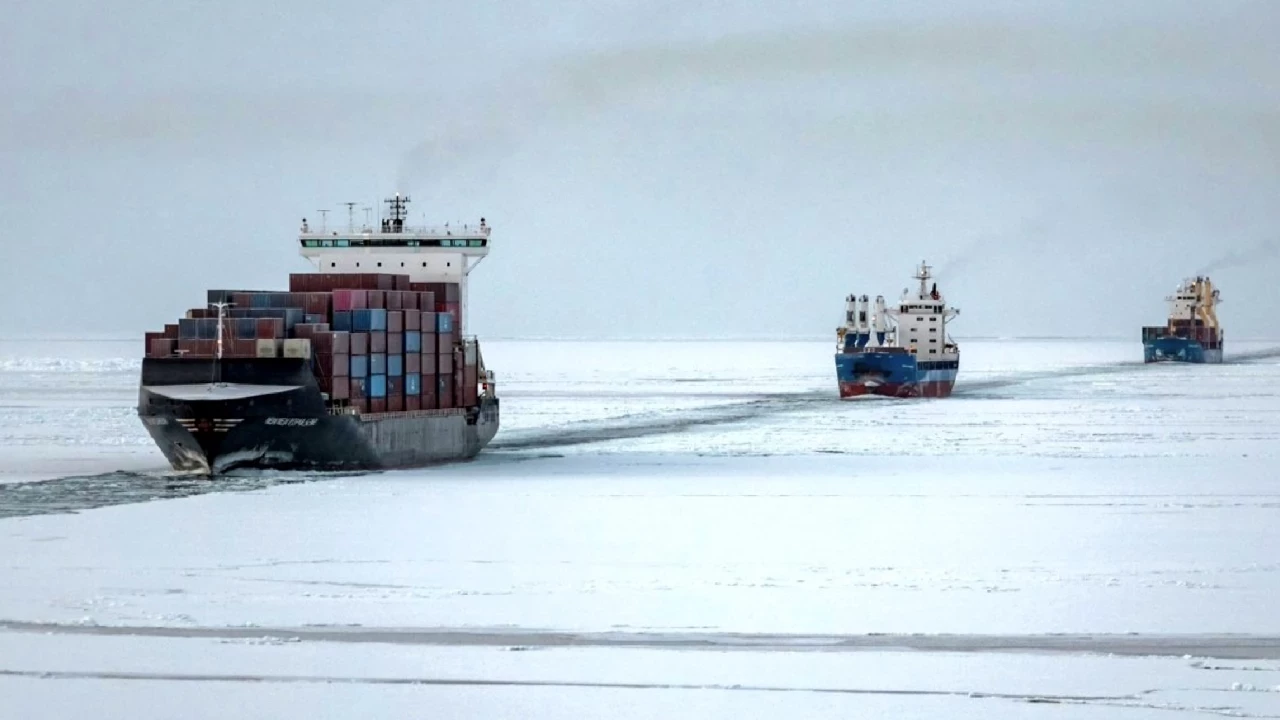
Trump's focus on Greenland highlights the Northern Sea Route's potential in global trade, reducing transit times and costs significantly.
Trump's clear emphasis on strategic objectives regarding Greenland since taking office continues to keep Arctic trade routes, which are gaining importance, at the top of the global agenda. Research indicates that sea ice in the Arctic region has decreased by over 75% since 1979, making the Northern Sea Route (NSR) more accessible. It is noted that using the NSR could shorten the transit time on the Europe-Asia route by approximately 40% compared to traditional routes.
U.S. President Donald Trump's remarks about acquiring Greenland under U.S. control have reminded us of the importance of the Arctic region, particularly the Northern Sea Route (NSR), in terms of trade competition.
Since taking office, President Trump’s clear emphasis on strategic objectives regarding Greenland continues to keep Arctic trade routes, which are gaining importance, at the top of the global agenda.
Due to its strategic geographical location, Greenland is vital for the U.S. in terms of ballistic missile early warning systems against military threats that may come from Russia and other countries. Additionally, it draws attention with rare earth elements, critical minerals, and energy resources that are expected to become accessible due to glacial retreat.
Trump's initiative is seen not only as an effort to strengthen the U.S. military and political presence in the Arctic but also as a reflection of the increasing competition for Arctic maritime routes that could play a critical role in the future of global trade.
In recent years, accelerated ice melting due to climate change has provided longer and broader navigation opportunities in the Arctic Ocean, while new maritime routes that could shorten the distance between Asia and Europe are increasingly being discussed. This situation brings back the feasibility of alternative routes that could reduce dependency on the Suez and Panama canals.
NSR shortens time and reduces costs.
A study titled 'Changing Oceans and Maritime Transportation: New Routes and Geographical Suitability in the Arctic Region,' conducted by researchers from Istanbul University’s Institute of Marine Sciences and Management and Dokuz Eylul University, reveals that the NSR, opened due to climate change, shortens transit times and reduces costs in transportation between Europe and East Asia.
According to information compiled by an AA reporter from the study, the NSR provides significant advantages for northern and eastern ports, while the Suez Canal remains more suitable for southern endpoints like Singapore.
The research indicates that sea ice in the Arctic region has decreased by over 75% since 1979, making the NSR more accessible. It was noted that using the NSR could shorten the transit time on the Europe-Asia route by approximately 40% compared to traditional routes.
In the study comparing distances from European ports to Asia, it is revealed that the NSR is shorter and more cost-effective compared to the Suez Canal.
Accordingly, the distance from the United Kingdom's Felixstowe Port to Singapore is 8,219 nautical miles via the Suez Canal and 9,597 nautical miles via the NSR, while the distance to Shanghai is 10,456 nautical miles via Suez and 7,640 nautical miles via NSR, to Hong Kong 9,679 nautical miles via Suez and 8,313 nautical miles via NSR, to Busan 10,722 nautical miles via Suez and 7,186 nautical miles via NSR, to Yokohama 11,111 nautical miles via Suez and 6,817 nautical miles via NSR, and to Manila 9,560 nautical miles via Suez and 8,531 nautical miles via NSR.
The study observed that this situation also applies to other leading ports in Europe, and 39 scenarios were calculated for the Yokohama-Hamburg route with different speeds and ship types. As a result of these calculations, it was found that the NSR route provides advantages over the Suez Canal in almost all scenarios.
In some cases, costs are reduced by half.
The study revealed that depending on the selected ship type, icebreaker support, and speeds, the NSR can reduce costs by half in some cases.
In scenarios where ice-class vessels can operate without icebreaker support, time and cost efficiency reach the highest levels, while it is predicted that the Transpolar Sea Route could be completed in even shorter times than the NSR if ice conditions improve.
The study also established geographical thresholds based on port pairs. Accordingly, the NSR route between Bilbao and Yokohama takes 41 days at a cost of $368, while the same route via Suez takes 50 days at a cost of $503.
On the Bilbao-Singapore route, the NSR route takes 53 days and costs $492, while the Suez route is more advantageous at 36 days and $361. On the Copenhagen-Yokohama route, the NSR route takes 35 days and costs $305, while the Suez route takes 54 days and costs $543. On the Copenhagen-Singapore route, the NSR takes 47 days and costs $430, while Suez takes 42 days and costs $421, making it more favorable.
In calculations for Europe's southern border, on the Le Havre-Singapore route, the NSR route takes 49 days and costs $451, while the Suez route is found to be more advantageous at 39 days and $391. On the Le Havre-Manila route, both routes are completed in 44 days, with the NSR route costing $399 per container and the Suez route costing $442.
In light of all this data, the study emphasizes that the NSR provides a significant advantage in terms of time and cost between northern Europe and northern ports in East Asia, while the Suez Canal remains more favorable for southern endpoints like Singapore.
Experts point out that with the increasing importance of the NSR, the world's largest island, Greenland, has become even more significant for the U.S. However, they also highlight that despite the distance and time advantages offered by the NSR, it presents serious logistical challenges such as harsh climate conditions, limited port infrastructure, the need for icebreakers, and high insurance costs.
Source: SeaNews Türkiye


