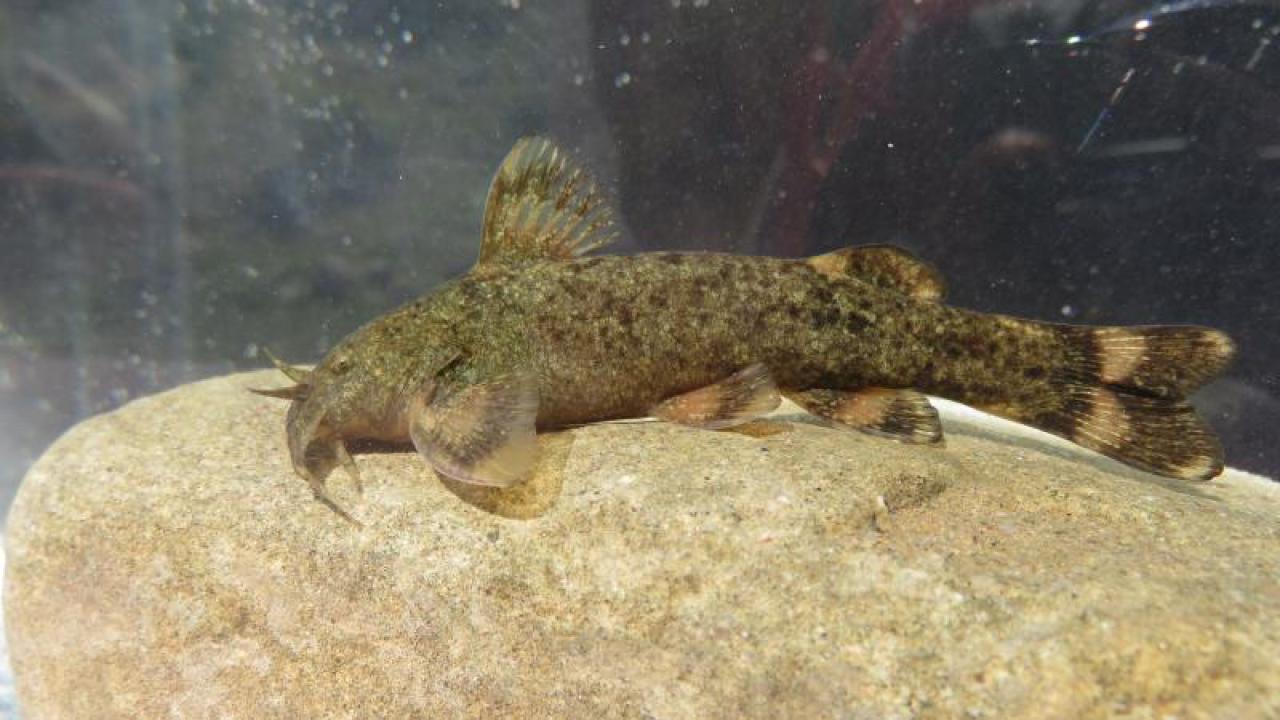
A study reveals that 38% of Turkey's freshwater fish species face extinction due to pollution, drought, and invasive species.
In a study conducted by RTE University under the coordination of the Ministry of Agriculture and Forestry's General Directorate of Fisheries and Aquatic Products, it has been determined that one in every three freshwater fish in Turkey is at risk.
Freshwater fish constitute a group of living organisms that inhabit freshwater environments such as rivers, lakes, and streams, including species like eels and some trout species that spend part of their lives in the sea. These fish play a key role in the balance of the ecosystem and are central to the food chain.
The presence of these fish is also considered one of the most important indicators of the health of water resources.
In this context, a research titled 'Critical Control List of Freshwater Fish in Turkey (2026)' was conducted under the coordination of the Ministry of Agriculture and Forestry's General Directorate of Fisheries and Aquatic Products, which shows the current status of inland fish and basins in Turkey.
The research, led by Assoc. Prof. Dr. Cüneyt Kaya from the Department of Freshwater Biology at the Faculty of Fisheries of RTE University, received contributions from 25 academics and experts from various institutions.
Assoc. Prof. Dr. Cüneyt Kaya stated that within the framework of the research, they prepared a checklist to identify newly defined and invalidated species, eliminate uncertainties arising from scientific changes, and clarify the number of freshwater fish species with current data.
Kaya noted that with the checklist, they identified the distribution areas of freshwater fish, the threats they face, and their status on the red list, stating, '55% of the 367 native fish species in Turkey's inland waters are endemic, meaning they are unique to our country. In our research, we found that more than one-third, or 38% of these species, are currently facing the risk of extinction due to threats such as pollution, drought, and invasive species.'
Kaya emphasized that Turkey has nearly as many species of freshwater fish as Europe, noting that a total of 390 freshwater fish species have been identified, of which 367 are native.
Highlighting that 23 of these freshwater fish are now foreign species that have successfully reproduced and become established on their own, Kaya stated, 'We do not want these species because they are not the natural species of this region and have invasive potential. They can pose a threat to our native species, but the good news is that we have 202 species that are unique to Turkey, that is, endemic.'
'Antalya stands out with 28 species in terms of the number of endemic species.'
Kaya pointed out that the Sakarya River stands out in terms of species richness, continuing, '65 species have been listed in the Sakarya River. Antalya stands out with 28 species in terms of the number of endemic species. The highest number of foreign species is also found in the Sakarya River, with 10 species. Unfortunately, we have lost 6 of our species in our inland waters; they are extinct. We have deep concerns that this number will increase even more in the coming period due to the rapid progression of drought, which has been increasing logarithmically, especially in recent years.'
Kaya reported that the six extinct species are the Gölcük toothcarp living in Gölcük Lake, the Diyarbakır stone loach in Göksu Stream, the Adana pearl mullet in the Seyhan and Ceyhan Rivers, the Gövce in the Beyşehir Lake basin, the Kavinne in Eğirdir Lake, and the Amik carp living in Amik Lake in Hatay.
'The economic loss caused by all invasive species is $4.1 billion.'
Kaya emphasized that endemic freshwater fish are most concentrated in closed basins and completely isolated river systems, stating, 'Particularly, the Beyşehir, Eğirdir, Burdur, and Konya closed basins, as well as small streams and lakes in Western and Southern Anatolia, have come to the forefront. In these areas, each basin has essentially produced its own fish, its own species. The most important step for conservation is to protect these systems in their natural state. Problems such as unplanned dams, excessive withdrawal of water, pollution, and the release of foreign fish must be eliminated and closely monitored. Because these species do not live anywhere else. If they disappear, there will be no return.'
Kaya reminded that although not every foreign species is invasive, they can potentially suppress native species and reproduce rapidly, so aquarium fish should especially not be released into environments where they do not belong.
Kaya noted that the economic burden created by such situations is quite significant, stating, 'Between 1960 and 2022, the total economic loss caused by all invasive species in Turkey, not just fish, amounts to $4.1 billion. We are talking about a massive figure.'
Kaya emphasized that the most effective way to prevent the spread of foreign species is education and awareness. He stated that preventing the entry points and spread of foreign species is much more effective than controlling them after their numbers have increased, adding that this could reduce ecological and economic losses.
Source: SeaNews Türkiye