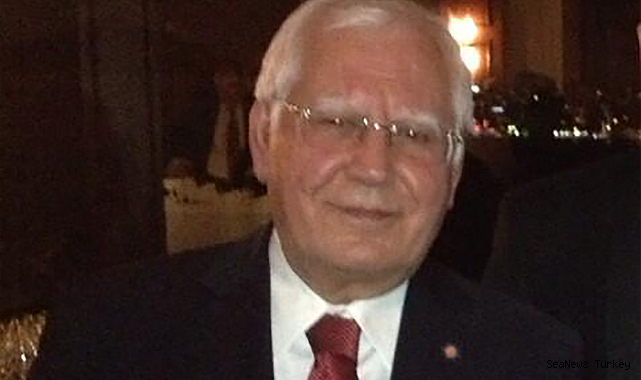

Refik Ağabey would send me his writings, which we published in DenizHaber. He often questioned why comments were not published, suspecting deletions.
Refik Ağabey used to send me his writings. We would publish them in DenizHaber. A few days would pass, and the phone would ring. "Cahit, why aren’t these comments being published?" He would suspect that someone was deleting the comments left under his article. I would open the site and check. The comment section was functioning properly. Nothing had been deleted.
At that time, I didn’t understand. I searched for the fault on the screen. However, Refik Ağabey was not asking me a technical question. He was asking like a captain calling on the radio from the bridge and waiting for a response. A sailor knows. You make a call, and the channel goes silent. You call again. As the silence prolongs, one first suspects the device. Because it feels heavier to think that no one is listening on the other side.
He knew where a piece of writing could take a person from his own life. He recounts this in an interview he gave to SeaNews in 2019. Born in 1927 in Ordu, he was four years younger than the Republic and the son of a teacher. After finishing Trabzon High School, he came to Istanbul during the war, waiting for days for a train. His dream was to study medicine. They didn’t accept him because he was only sixteen. During those days, he published a story every evening in the Akşam newspaper. One evening, at the end of a story he read, he saw an advertisement for the Maritime Academy. If he hadn’t read the story, he wouldn’t have seen the ad, even if it were on another page. That ad took him to the door of the school by the sea in Ortaköy. The last line of a story became the first line of a life.
In the same interview, my favorite memory of him takes place on an Ardahan freighter. The year was 1951, and he was a third officer. They had loaded wheat destined for Italy in Derince. The captain handed him a pink paper and asked him to prepare a time sheet. It was a word he was hearing for the first time. He didn’t hide his ignorance; he openly said so. The ship’s second officer handed him a book. He read it on the way to Italy. By the time they arrived at the port, that schedule was now his responsibility.
Refik Ağabey’s entire life is visible to me in that scene. A young man honest enough to admit he doesn’t know. A colleague who does not withhold the book in his hand. And in between, a long sea route open to reading.
Maritime teaches a person this. You get stuck on a custom in a port, a word on a ship. You see that a job you thought could only be done one way in your homeland can be done quite differently there. At first, you are surprised, then you think. When you return home, you look at things you have taken for granted for years with a different perspective. The eye that sees its own culture above all else softens as it gets to know other worlds. A person continues to love their own, but learns to value others as well. Ports enlighten sailors in this way.
This is how I came to know Refik Ağabey. He thought with his own mind. Kant defines enlightenment as the courage to use one’s own reason. Refik Ağabey’s generation received the same lesson from Atatürk, knowing him to be the most authentic guide in scientific life. He did not seek another guide throughout his life. He took pleasure in learning what he did not know.
An enlightened person has two paths before them. They either keep the light to themselves or share it. Refik Ağabey chose the latter. As a student, he filled two notebooks with the English equivalents of maritime terms. Those notebooks turned into a dictionary that he pursued every word for twenty-five years. He published the Maritime Trade book with his retirement bonus. He taught young sailors, published a magazine for children. He published his dictionaries online for free and called himself “the man who circulates dictionaries for sailors in the sky.” He considered all this effort a debt of gratitude for the interest he received at his school. Years later, he handed the book that a colleague had given him in Ardahan to sailors he had never met.
Ibn Khaldun states in the Mukaddimah that knowledge and art only develop where there is interest. According to him, knowledge increases in a society that has seekers, where civilization progresses. This means that there must be as many readers as there are writers, as many curious minds as there are narrators. The asabiyyah in the same book, the sense of solidarity that binds people together, was in Refik Ağabey his commitment to his profession and to the youth in that profession. He gave more than his share. He did not expect wealth or position in return. He awaited a question. A challenge, a “I didn’t understand this part” awaited him. Every writer wants to be read, wants to be understood. When society’s curiosity cannot keep up with what the writer provides, only those phone calls remain.
Today I think. There was indeed a force that deleted the comments, Ağabey. Its name was indifference. We were also part of it. Did we manage to establish that conversation with you sufficiently?
Even if he was broken, he did not hold a grudge. He would still call. “I have a piece to write,” he would say. While talking about one piece, his mind would already be on the next. He was ninety-nine years old and still spoke of the work he had to do. Attila İlhan describes in An Gelir how the old excitement within a person can suddenly extinguish one day. That moment never came for Refik Ağabey. His body aged, but his excitement did not. What kept him standing were the tasks that lay ahead of him, far beyond the years he left behind.
A lighthouse burns without expecting thanks from ships. But it is the person who lights the lighthouse. A person also wants to know that their light guides a ship. How many young officers’ first time sheets, how many students’ exam nights were illuminated by Refik Ağabey’s light, he himself could not know. We knew. We were late in saying it.
We lost him on November 11. Yesterday afternoon, we gathered at Şakirin Mosque. The short reign that Cahit Sıtkı Tarancı announced to all of us at the end of Thirty-Five Years, that last dignity lasting the time of a prayer, was Refik Ağabey’s yesterday. Then we buried him in Karacaahmet. Up until that stone, I believe he did his duty in this world properly. He enlightened, and he illuminated. He did not keep the light to himself.
In November, another leaf fell from the branch. The leaf falls, the tree remains. His books are still on the shelf, his dictionaries are still circulating in the sky. Now, when I open one of his writings, I want to search for him this time. To say, “Ağabey, I read your piece. Can we talk a bit?”
Your call was received, Refik Ağabey. It was late, but it was received.
May your path be clear, and your destination bright.
Source: SeaNews Türkiye